Becoming an Inclusive University: Diversity Symposium 2026
Inclusivity was at the heart of this year's Leiden University’s annual Diversity & Inclusion Event. Students, staff and alumni came together to share perspectives, stories and practical tools for change.
How can our university become more inclusive? This question was at the heart of the annual Diversity & Inclusion Symposium at Leiden University. The programme combined plenary discussions with interactive breakout sessions and focused on inclusive learning environments, accessibility, and practical approaches to diversity and inclusion in research, teaching and leadership. At Leiden University, the aim is to support the development of inclusive learning environments; ones that acknowledge personal and cultural frames of reference, individual learning needs, diverse knowledge, and the different experiences of students and staff.
A diversity of perspectives promotes the development of new knowledge, skills, and encourages action towards equity in learning, teaching and working environments. The aim of the event was to spark conversation about how different perspectives can help create a collective sense of responsibility for change, and to share practical tips and tools for everyday university practices.
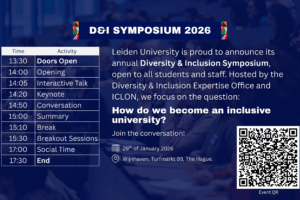
The afternoon opened with a welcome by Nivja de Jong, Professor of Second Language Acquisition and Pedagogy, affiliated with Centre for Linguistics and the Graduate School of Teaching (ICLON). In her introduction, she spoke about the role of language in education and inclusion and how language shapes participation in academic settings.
The interactive talk featured Judith Jansen (Policy Adviser for Diversity and Inclusion), Ahmed Mahfouz (Associate Professor at the Department of Human Genetics at LUMC and Chair of the Young Academy Leiden), and Avalon Leiman (student at Leiden University College and disability rights advocate). They reflected on inclusion in both research and education.
Mahfouz spoke about the importance of diversity in research environments and referred to international developments affecting academic freedom. Leiman shared preliminary findings from her research on the accessibility of university buildings, and stressed that inclusion must take into account a wide range of disabilities, including non-visible disabilities. Jansen reflected on the steps the university has taken in recent years, including toolkits and training initiatives, and highlighted the importance of embedding these efforts structurally.
The keynote lecture, Bouwen aan een inclusieve universiteit, was delivered by Saniye Çelik, Professor of Diversity and Inclusion of the Police. Drawing on four decades of experience, she discussed social safety, professional standards, leadership responsibilities and how organisations interpret inclusion data.
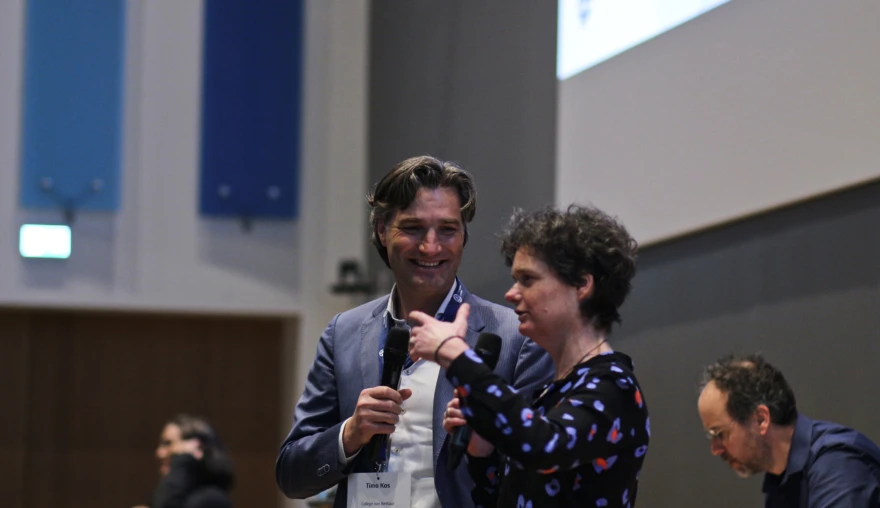
The plenary session ended with a conversation between Nivja de Jong and Timo Kos, Vice-President of the Executive Board. Kos shared experiences of gender bias in professional settings and spoke about the importance of recognising and addressing exclusionary behaviour. A poetic summary of the plenary session was presented by Peter Rombouts.
Discussion Spaces & Round Tables
In two rounds, participants chose from sessions focused on discussion, research findings and practical approaches. The formats included discussion spaces, round tables and workshops. These sessions offered space for moderated debate, in-depth exploration of specific topics and active participation. Following are descriptions of each session.
The Learning Circle
Nadia Mansouri, Steven van Wijk & Rosalinde Spitters (Faculteit Sociale Wetenschappen)The POPcorner, in collaboration with the Policy Office of Education and HR, initiated The Listening Circle (TLC) to support a sustainable focus on diversity, inclusion, and wellbeing. During the workshop, they presented their connective approach and facilitated a TLC conversation that generated insights and actions participants could apply within their own circles of influence.
Burgerschap en activisme
Arthur Pormes & Nika Hendriksen(ICLON)
Participants exchanged ideas and took part in discussions about “The university and citizenship education.” The open format facilitated dialogue, allowing participants to contribute at their own pace. It proved relevant for educational settings and other contexts where people engaged in conversation. Participants not only actively joined discussions but also saw how open dialogue fostered inclusive participation and supported an inclusive learning environment.
Teaching disciplinary literacies
Tessa Mearns (ICLON)
Diversity and inclusion are high on the agenda in higher education. Research within the public sector shows that inclusive leadership plays a crucial role in creating an inclusive working environment. But what does this mean in practice? And how can professionals and managers actively shape an inclusive working environment in their daily work? In this session, participants entered into dialogue using the Inclusive Leadership Game. The game provided a structured and safe setting to explore experiences, perspectives and dilemmas. It also helped participants develop a shared language to make inclusivity discussable, recognisable and comparable. Rather than a theoretical lecture, the session focused on reflection, exchanging perspectives and meaningful interaction.
Facultative or curricular implementation of skills-trainings: Do inclusion and diversity ask for different approaches?
Joram van Ketel, Arjen de Vetten & Max van Lent (Faculty of Law)The challenges that students face during the transition to higher education (HE) contribute to dropout. Institutions therefore develop promising interventions to improve student well-being, sense of belonging, and academic engagement. An important question for implementation is to make such trainings facultative or curricular. Embedding in curricula is not always sensible or technically possible, while facultative initiatives face low uptake and/or fail to reach students who are most in need, such as first-generation-students (FGS). We evaluated the impact of short curricular training with a (quasi-)experimental design in the Faculty of Law. In this round-table discussion, we presented results showing the effectiveness of the training. We then opened the table to discuss considerations to either implement such initiatives as part of the curriculum or offer these facultatively.
Teaching inclusive design skills
Amer Jaganjac (ICLON/Fontys Hogeschool)
At this round table, a study was presented on the characteristics of teaching approaches for inclusive design in science education. We discussed the benefits and challenges of teaching inclusive design, placing the spotlight on educators as key agents of inclusion.
Inclusive leadership in higher education
Elly Taal (ICLON/The Hague University of Applied Sciences) Diversity and inclusion are high on the agenda in higher education. Research within the public sector shows that inclusive leadership plays a crucial role in creating an inclusive working environment. But what does this mean in practice? And how can professionals and managers actively shape an inclusive working environment in their daily work? In this session, participants entered into dialogue using the Inclusive Leadership Game. The game provided a structured and safe setting to explore experiences, perspectives and dilemmas. It also helped participants develop a shared language to make inclusivity discussable, recognisable and comparable. Rather than a theoretical lecture, the session focused on reflection, exchanging perspectives and meaningful interaction.
Designing intercultural online collaborative learning in Higher Education: a systematic review
Catur Wulandari (ICLON)
Intercultural online collaborative learning has increasingly been adopted in higher education to provide students with international and intercultural learning experiences through digital collaboration. Despite a growing body of empirical research, studies often examine collaborative learning elements without sufficiently accounting for the contextual conditions in which they operate. This systematic review addresses the question: What elements are at play in the design of intercultural online collaborative learning in higher education? The findings identified four recurring design elements and show challenges and opportunities.
Workshops
During these sessions a project or topic was presented by experienced staff. The workshop leaders introduced an activity in which participants engaged in group discussion and creation. The aim of these sessions was both deep substantive information transfer and getting to work with material or topic.
Rehearsal for change: Theatre as a method to understand and challenge inequity
Ieke van Dam (ICLON)
In this workshop, the moderator showed, as a theatre teacher and researcher, how to better understand topics such as marginalisation, power structures, and discrimination through theatre and to rehearse how to react when you witness or experience such a situation. The theatre method used, Theatre of the Oppressed, developed by Augusto Boal, is renowned worldwide and is used by marginalised groups to share stories and bring about grassroots change. In this workshop, it is expected to participate in several theatre exercises and, using a dramatised case study from research on diversity and inclusion in teacher education, contribute to expanding our shared understanding of the issue presented. Sharing knowledge and experiences helps us truly make the university a place where everyone feels at home.
Managing difficult moments in the classroom
Aayushi Shah & Looi van Kessel (Faculty of Humanities)
The classroom can pose many different challenges for an instructor who often has to respond quickly to difficult moments that might arise from disruptive behavior or political disagreement between students. Many instructors don't always feel equipped to respond adequately to classrooms that become increasingly complex. This workshop offers a practical opportunity to understand how to manage difficult classroom moments while considering the positionality of yourself and others in these critical situations. Through detailed case analyses and interactive problem-solving in a group setting, participants reflected on and developed concrete strategies for responding thoughtfully and constructively to such situations.
Contributing ideas to the [s]TATTOO Studio
Art PartnerIn March and April, the [s]TATTOO Studio will visit each faculty of the university. It is an artistic intervention centred on listening. Participants were invited to allow themselves to be heard and to allow their stories to be transformed into artwork within the [s]TATTOO Studio. In this workshop, participants were introduced to the idea behind the studio and explored questions such as: What does social safety and inclusion require at our university? Which stories need to be heard? And what approach is needed to make the studio meaningful for Leiden University?
The [s]TATTOO Studio is an artistic intervention developed by Art Partner with artists Maze de Boer and Peter Rombouts.
From good intentions to real change: D&I in university practice
Adriaan Norbart, Kirsten Langeveld, Nour al Kuhaili & Raju Talwar (LUMC)
Diversity and inclusion are high on the agenda at Leiden University. But how do you ensure it becomes more than good intentions? And what does this concretely require from you as a lecturer in your daily work? In these in-depth workshops, participants worked with practical cases from the university context. How do you approach D&I from a policy perspective as a lecturer? How do you deal with resistance from colleagues who do not see D&I as relevant? And how do you organise inclusive activities that go beyond standard social events? Participants explored where their influence lies and which organisational choices are needed to embed inclusion structurally. The second part focused on everyday practice, reflecting on experiences of othering in education and exploring how to act as a bystander using the 5D model of bystander intervention. Participants left with insights, concrete actions and reflection points.
Closing
The event concluded with informal networking between 17:00 and 17:30. The symposium combined reflection on institutional developments with practical examples from research and teaching. Across plenary and breakout sessions, participants discussed accessibility, language, leadership, curriculum design and classroom practice as elements contributing to a more inclusive university environment.


0 Comments