
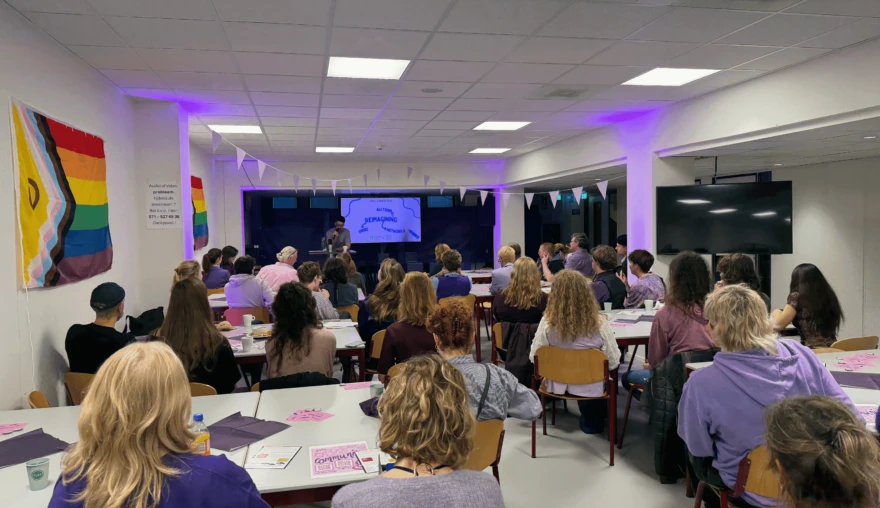
Purple Friday Gathering: Conversations on Pride, Community and Allyship
On Purple Friday, Student organisation Queer Leiden University and representatives from different faculties (with the support of the D&I Expertise Office) organised the 2026 Purple Friday Gathering. These gatherings are a yearly occurrence which over the past four years has grown into a significant yearly conversation between people of all ranks.
Purple Friday itself is an annual action day in Dutch education dedicated to showing support for LGBTQIA+ students, staff, and communities. This year, the national Purple Friday campaign was moved from its traditional place in December to 9 October, with the aim of increasing visibility earlier in the academic year. Yet the colour at the heart of the day carries a meaning that reaches beyond visibility alone.
Purple Friday and the Meaning of Purple
In Gilbert Baker's original eight-colour Pride flag from 1978, purple represents spirit, the shared strength, resilience, and unity that, in part, defines the LGBTQIA+ community. Yet for Dean Sarah de Rijcke, this colour carries additional significance. During her inaugural address, she noted that purple is resistant to simple categorisation. It exists in the space between definitions, elusive and impossible to pin down to just one interpretation. Queerness works much the same way: it's fundamentally about rejecting narrow labels, welcoming nuance and contradiction, and claiming the right to flourish outside of confining structures. Her closing message was
Reimagining Pride
This dual understanding of purple as both a symbol of community solidarity and a representation of the power to transcend definition set the stage for the afternoon's meaningful discussions on the reimagining of Pride, networks, and allyship.
After a brief breathing exercise to help those attending feel more grounded, a panel consisting of representatives from LGBTQIA+ organisations and university networks explored the themes of Pride, community-building, and allyship. The discussion opened with a reflection on Purple Friday itself: a day that functions both as a celebration of LGBTQIA+ identities and as a moment to reflect on the progress that has been made, as well as the challenges that remain.
When discussing the meaning of Pride, panel members emphasised that Pride has always encompassed multiple dimensions. Beyond celebration, it creates visibility, provides space for community, enables access to resources, and serves as a form of protest. Several speakers highlighted that representation and visible role models can play an important role in fostering acceptance and belonging. At the same time, participants reflected critically on the evolving nature of Pride, noting ongoing debates around commercialisation, political engagement, and ensuring that Pride remains connected to the communities it seeks to represent.
The conversation also examined the relationship between institutions and community networks. Panel members shared experiences of organising events and highlighted the importance of sustainable support structures. Effective institutional support was described as more than financial assistance alone. Participants stressed the value of knowledge sharing, continuity, accessible communication channels, and practical support for volunteers, who often carry a significant organisational burden. Throughout the discussion, speakers advocated for a bottom-up approach, in which networks are listened to and empowered to shape their own priorities while remaining connected to the wider university community.
Networks, Community, and Support
A recurring theme was the challenge of balancing institutional involvement with community autonomy. Participants spoke about the importance of maintaining independent voices within networks while also creating opportunities for dialogue with university leadership. Suggestions included strengthening consultation mechanisms, increasing opportunities for networks to provide input on relevant appointments and policies, and ensuring that the expertise present within communities is recognised and valued.
The final part of the panel focused on allyship. Speakers described allyship as an active practice that extends beyond individual behaviour. Examples included using and respecting people's pronouns, addressing exclusionary or hurtful behaviour when it occurs, and creating space for marginalised voices to be heard. Institutional allyship, participants argued, should recognise the diversity of needs and experiences within LGBTQIA+ communities rather than assuming a single, unified perspective.
Institutional and Individual Allyship
Throughout the discussion, participants returned to a central question: how universities can contribute to an environment in which all members of the community are able to participate fully and authentically. The panel concluded by emphasising the importance of continued dialogue, meaningful action, and shared responsibility in creating an inclusive academic environment.
Following the panel, attendees continued these conversations in facilitated small-group discussions, where participants reflected on the themes raised and shared ideas for future action and collaboration.


0 Comments